Phase 4 intervention study
Reproduce: python studies/phase4_intervention.py. Numbers come from that script; raw output in
phase4-results.json, figure in figures/.
Scope. Measured on deterministic fakes (canned verdicts, a decay editor that models a working repair), not real models. It demonstrates the intervention mechanics — routing, trust aggregation, MADERA convergence, and the halt→repair→recover loop — and answers the honest question the trust heuristic has to answer.
1. Does trust-weighting beat uniform? (the ablation)
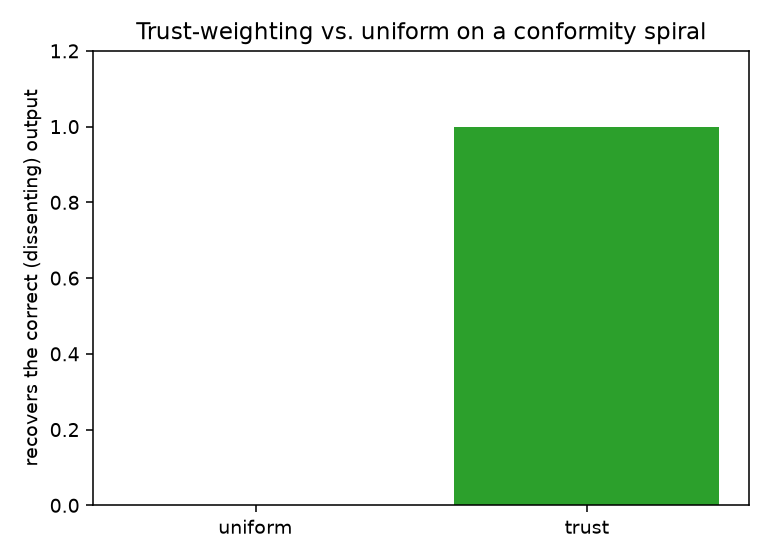
The scenario is a conformity spiral: three overconfident skeptics (high confidence, no evidence) insist the biased output STANDS, while one evidence-backed dissenter says REVISE and proposes the fix.
| Aggregator | Decision | Recovers the correct output? | Dissenter pruned? |
|---|---|---|---|
| uniform (baseline) | stands |
❌ no | no |
| trust | revised |
✅ yes | no |
Uniform majority-votes the biased consensus and the correct output is lost. Trust-weighting prunes
the three overconfident agents (majority_1/2/3) and the evidence-backed dissenter carries the
decision. Trust earns its place here — but note why: it helps precisely because the majority is
overconfident-without-evidence. It is not a universal improvement, and uniform remains the default
baseline; this is the specific regime (a conformity spiral) where trust is the right tool.
Crucially, in both modes the dissenter is never pruned — the minority-suppression guarantee.
2. MADERA converges
Iterative diagnose→retrieve→rewrite (decay 0.4 per pass, threshold 0.1):
| Injected bias β | Converged? | Rewrites |
|---|---|---|
| 0.3 | ✅ | 2 |
| 0.5 | ✅ | 2 |
| 0.8 | ✅ | 3 |
Larger initial bias needs more rewrites, but all converge within the cap. A repair that does not
reduce bias would hit max_rewrites and return flagged not-converged (tested separately).
3. The full loop drops B_net
An end-to-end halt→repair→recover with the M3 control machine and the MADERA runner:
| Value | |
|---|---|
B_net before |
0.80 |
| halt state | intervention |
| strategy routed | madera (concentrated bias) |
B_net after repair |
0.072 |
| control state after | normal |
A biased payload trips the breaker; the runner routes to MADERA (the bias is concentrated in one
node); the repaired payload re-scores at 0.072, below tau_exit, so the control machine returns to
Normal. The loop closes with no coupling beyond M3 re-measuring B_net.
Takeaways for M5
- The intervention layer produces an auditable trail (verdicts, pruned agents with reasons, MADERA rewrites) — M5 turns that into the causal audit record and SARIF export.
- Trust-weighting is genuinely useful but regime-specific; M5's reporting should make the pruning decisions and their reasons visible so an auditor can judge them.